
Think of a group of about 4 to 25 people that you currently belong to or once belonged to. For example, think of a group of friends on a trip or a party, a team or small department in your job, a class of students in high school or college, or a group of volunteers in a community project.
For the group you have in mind, would you be able to come up with a yes/no opinion statement, for which about 50 percent of the group members would say ‘yes’, and 50 percent would say ‘no’? Even with a 60 / 40 divide, would you be able to come up with one or more such statements? For clarity, we are talking about basic opinion statements that can be answered with either ‘yes’ or ‘no’. Think of statements like:
- “Should we go rafting with the team?”,
- “Should we have our meetings on Fridays?”,
- “Is it acceptable to put pineapple on a pizza?”,
- “Is there enough diversity in this group?”
The other way around, for statements like these, would you be able to guess for the group you have in mind the respective percentage of ‘yes’ and ‘no’ responders?
To find out, you can give it a try at your next team event, class discussion, or party. For example, let everyone write a statement down for which they think the divide is within the 40-60 percent range of ‘yes’ responses, and the no respondents in the other 60 to 40%. Alternative answers like ‘maybe’, ‘it depends’, or ‘I don’t have an idea’ are not allowed. Afterwards, collect the statements, and do a group vote for each of them. Whoever is closest to 50% wins the consensus guessing game.
A handful of people might be more-or-less good—or lucky—at assessing opinions in groups and knowing the topics that have no consensus. However, most of us are not good at assessing the opinions of others, especially when we do not know them well. A major reason for this shared inability to accurately guess shared opinions in groups is that our own opinions on these statements influence our estimates of opinions in groups. When assessing opinions, we assess, in fact, the level of agreement with our own opinion.
Overestimating the degree of consensus with our own opinion is referred to as the false-consensus effect. In contrast, underestimating the degree of consensus is the false-uniqueness effect. Common reasons for having both biases – often occurring simultaneously in the same group of people – are social barriers that some people feel to speak up, too much or too low confidence in one’s own judgment, unbalanced access to information or opinions of others, the lack of opportunities in a group to exchange ideas, (too) strong traditions and norms, and having a few dominant personalities in the group.
Common consequences of having such strong effects among group members are that collectively made decisions are seldom executed well by all, people feel not fully or only partially included, good ideas might get lost, and necessary action and change remain ignored.
When you do any variation of a consensus guessing game in a group, you will soon see that it will likely not remain limited to mere voting for statements. The consensus guessing game is a very basic and straightforward way for people to get an insight into their false-consensus and false-uniqueness estimates, in general, and/or for specific topics.
With a good group facilitator, team managers, or class teacher—mainly in the context of work or education—themes can be further elaborated, discussed, and clarified. When necessary, even a new round of statement formulations and voting can take place. A safe and playful discussion environment is a necessary condition, so that group members can speak up and share statements, vote on them, and discuss outcomes openly. Nevertheless, creativity with online submission of statements, as well as voting on them, can solve many initial barriers. Spreading over time, for example, across different meetings or classes, the statement formulation, voting, and discussion, is another way to alter group discussions with individual reflections. Similarly, extra creative options are also possible to move beyond simple yes/no statements, and making it easier for people to suggest statements, vote on them, and discuss them.
In sum, a consensus guessing game is an easy micro-intervention with high potential for improving group dynamics.
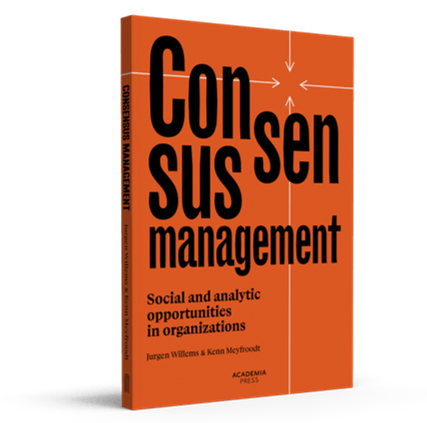
More information, tips, and insights in Chapter 2 ‘Explore’ of our book: Consensus Management.

 The Consensus Project